
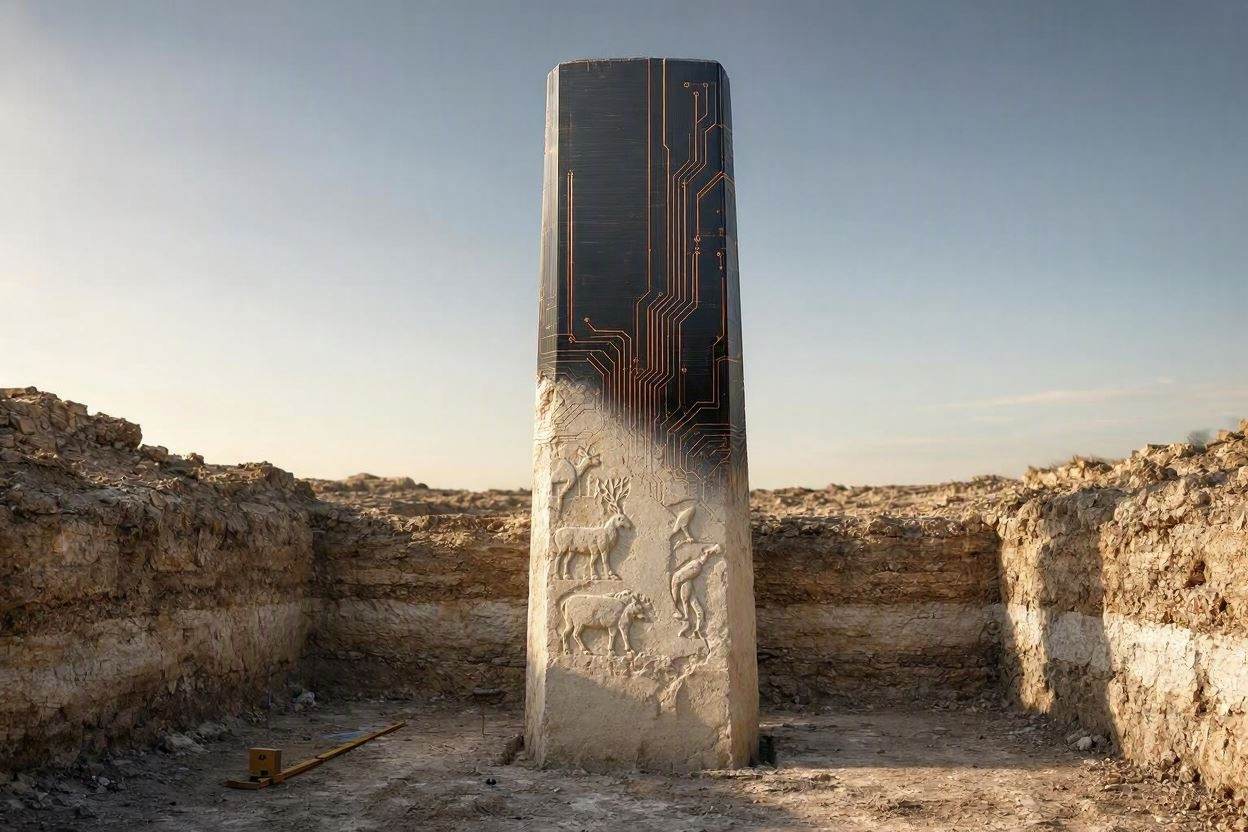
War is no longer waged only at the border, on the front line or across cyber networks; it is increasingly moving into the human mind. Algorithms can influence what we see, artificial intelligence can shape what we understand and how, and political and economic actors can determine which of our fears will grow. This dossier examines the new question of sovereignty in our age: will a society be able to preserve the power to construct its own reality and to remain the owner of its own convictions?
For a long time, humanity thought about sovereignty through maps. Borders showed where the state began and ended; armies protected those borders, navies protected the sea lanes, and intelligence services protected state secrets. In the industrial age, oil wells, energy lines and factories were added to this security architecture; when the digital age arrived, data centres, communication networks, satellites and cyber infrastructure became the new strategic assets of states. Today, however, a border more invisible than any of these is emerging. It has no barbed wire, no coordinates, and no flag flying over it. And yet it is important enough to shape the political future of a society, the resilience of a state, and even the choice between war and peace: the mental space in which human beings perceive reality.
Can a country's behaviour be changed without its territory being occupied? Is it possible to weaken social order without bombing power plants, to systematically steer the convictions of voters without removing ballot boxes, and — without telling people any outright lie — to alter which events they fear, which groups they resent, and which information they trust? Until a few years ago these questions might have been considered the subject matter of psychology, communication studies or propaganda research. Today, another concept is becoming increasingly visible in the documents of security institutions from NATO to the European Union: cognitive warfare.
The change here is not merely terminological. NATO's Allied Command Transformation treats cognitive warfare as the totality of military and non-military activities aimed at gaining an advantage over human perception and decision-making processes. NATO's own formulation is particularly striking: in this struggle, the human brain is both the target and the instrument. Seen this way, war expands beyond destroying a country's military capacity towards shaping what the society behind that capacity sees, believes and how it decides. This is not a new name for propaganda; it is the sign of a larger transformation.
From Propaganda to the Engineering of Reality
Propaganda may be considered as old as humanity itself. From the victory inscriptions of empires to religious struggles, from the posters of the First World War to the propaganda machine of Nazi Germany, from Cold War radio broadcasts to modern election campaigns, political power has always sought to reach the human mind. What makes our era different, therefore, is not that states or political actors wish to influence people. What is new is the capacity to identify whom they will influence, to measure behaviour, to personalise the message and to monitor the result in real time.
The fundamental problem of twentieth-century propaganda was to deliver the same message to as many people as possible. A newspaper printed millions of copies, the radio made millions listen to the same speech, television showed the same images to an entire country. The digital system, by contrast, can work in reverse. While millions of people are present on the same platform, each of them can encounter an entirely different flow of information. If one person is sensitive to narratives of economic collapse, content feeding economic anxiety may appear before them; if another is mobilised by migration, security, religion, ethnic identity or cultural threat, their information world may be shaped in another way. Over time, people living within the same society may come to hold not merely different political opinions, but different depictions of reality.
It is precisely here that the distance between propaganda and cognitive influence opens up. Propaganda usually tries to tell you what you ought to think. The algorithmic information order, however, often does not need to tell you directly what to think; it is enough for it to determine what you will see more of.
This small difference may turn into one of the greatest political transformations of our age. For human beings do not understand the world solely by evaluating the information presented to them; what never appears before them also shapes their conception of the world. When an event is made constantly visible it can feel more widespread than it is; when a threat is repeated constantly it can feel closer than it is. Conversely, when other events remain outside the algorithmic flow, they may find almost no place in social consciousness even if they are objectively of great importance. Thus power shifts from the struggle between true and false to the struggle between visible and invisible.
This transformation lies at the heart of the European Commission's view of information manipulation as a threat to democratic systems. The Commission notes that new technologies give hostile actors the ability to spread disinformation at unprecedented speed and scale; that this can weaken informed decision-making, polarise social groups against one another, and erode the functioning of democratic institutions. It is for the same reason that the fourth FIMI threat report published by the European External Action Service on 12 March 2026 examines not so much individual pieces of false content as the systems that produce and carry them. The issue is no longer a handful of false news items; the information space itself is becoming the infrastructure of strategic competition.
The Geopolitics of Attention
Yet an easy mistake must be avoided here. If we explain the transformation of the human mind solely through covert operations run by foreign states, we may overlook what is perhaps the most powerful actor of all: the economic system.
A significant part of today's digital economy is built on converting human attention into economic value. From the platform's point of view, a user staying on screen a little longer, clicking on a video, becoming angry and leaving a comment, arguing with another user or sharing content is a measurable value. The natural tendency of such a system is not always to foreground the most accurate, most balanced or most important information; the content that generates the most engagement may gain the advantage. Given the psychological make-up of human beings, the consequences are unsurprising. Fear, anger, threat, belonging, humiliation and scandal often produce a stronger reaction than a calm explanation.
For this reason, two entirely different forces can meet at the same point in the modern information space. A state may wish to amplify social polarisation for strategic purposes; a platform may, with no political aim whatsoever, simply be trying to increase engagement. One acts from a geopolitical, the other from a commercial motivation — yet both can exploit the same cognitive openings in human beings. Thus the economic logic of the algorithm and the strategic logic of political manipulation occasionally converge.
From here, a new scarcity is added to the classical resources of geopolitics. Oil is limited, critical minerals are limited, advanced chip production capacity is limited; but human attention is limited too. That a day has twenty-four hours does not change. The real struggle, therefore, is waged not merely to produce information, but to determine whether the information produced will enter the limited field of human attention at all.
Attention is now not merely a psychological but a strategic resource.
This observation also forces us to rethink censorship in the digital age. In the past, one of the easiest ways to neutralise an idea was to ban it. You shut down the newspaper, confiscated the book, silenced the speaker. In today's world, sometimes nothing needs to be banned at all. You place so many images, comments, conspiracies, claims and counter-claims around the truth that people no longer know which one to investigate. The enemy of truth is not only the lie; sometimes it is noise.
Beyond this point, measuring the success of manipulation solely by whether people believe a piece of false information becomes inadequate. A far deeper outcome is possible: people may cease to believe that any information can be verified at all. They distrust the news, distrust the journalist, distrust the scientist, distrust the election result, distrust the court; they begin to see the government's statement as propaganda and the opposition's statement as another kind of propaganda. In the end, the person who believes that everything is manipulation has not — contrary to appearances — escaped manipulation; having lost the will to seek the truth, they have become more defenceless against it.
Trust Is Lost Before Truth Is
A political order is not built on constitutions, courts, armies, police or money alone. Beneath these lies a far more invisible capital: the minimum trust that people feel towards one another and towards shared institutions. Not everyone in a society needs to hold the same views; but a minimum common ground is needed — a belief that when an election is held the votes are counted, that when one goes to court there is a decision-making mechanism, that the data presented by a scientist is at least debatable, and that the person across from you is not entirely an enemy.
When this ground begins to disappear, the nature of political polarisation changes. Society is no longer debating different solutions; it can no longer agree on which reality exists. When war breaks out, the authenticity of images; during an epidemic, the legitimacy of scientific knowledge; on election night, the votes themselves; in an economic crisis, even basic statistics — all become part of an identity war. The energy of such a society is spent not on solving problems, but on arguing over whether the problem exists at all.
The most critical goal of cognitive warfare may therefore be subtler than spreading a particular ideology. Rather than giving a society a new belief, dissolving its existing relations of trust can produce a far more effective result. For when people trust nothing, the political system loses its capacity for collective decision-making. As the state weakens, another state's ideology need not necessarily emerge in its place; chaos itself can produce strategic results.
It is meaningful, then, that societal resilience and trust occupy such an important place in NATO's approach to cognitive warfare, and that the European Union, in countering information manipulation, emphasises not only content removal or verification mechanisms but also media literacy, media pluralism, civil society and research capacity. In the European Commission's approach, access to quality information, media freedom and a society's ability to recognise manipulation techniques are all parts of the same defence architecture. Because if the issue is genuinely cognitive, you cannot leave the whole of the defence to the state or to technology companies.
Cognitive Sovereignty
Here Pusula's proposition reaches further. A new category of sovereignty needs to be added to the strategic debates of the digital age: cognitive sovereignty.
State sovereignty denotes ultimate authority over territory; energy sovereignty, room for manoeuvre against external pressure in basic energy resources; digital sovereignty, the capacity for control over data and digital infrastructure. Cognitive sovereignty replaces none of these; rather, it describes an invisible layer running above them all. The issue is not a state telling its citizens what to think. The real question is this: how much say does a society have over the mental space in which it forms its own convictions?
This distinction is extremely important, because the path to misunderstanding cognitive security is short and its consequences are dangerous. When a state declares itself the sole owner of truth by saying "I am protecting society from manipulation," cognitive sovereignty has not been established. On the contrary, external manipulation has simply been replaced by internal domination. An order in which the state defines every opposing view as disinformation, every objection as foreign interference and every different interpretation as a security threat is not cognitively strong; it is merely afraid.
Genuine cognitive sovereignty is not a society of people who think alike. It is a society of people who can think differently yet are able to question why they think as they do.
For a democratic system, therefore, the paradox of cognitive defence is considerable. If you leave the information space entirely to algorithms and commercial interests, the capacity for manipulation expands; if you place the whole field under state control, you destroy free thought. The solution lies not in choosing one of the two, but in strengthening society's own capacity for judgement. Independent media, transparent institutions, media literacy, scientific thinking, strong education, pluralism and freedom of expression are not only democratic values here; they are also elements of strategic resilience. The European Commission's treatment of civil society, journalists, researchers and media organisations as parts of a "whole-of-society" approach against information manipulation rests precisely on this logic.
If Artificial Intelligence Becomes the New Mediator of Reality
The development that makes the question of cognitive sovereignty urgent is artificial intelligence. In the early stages of the debate, fear was largely concentrated on deepfake imagery. Videos showing a politician saying a sentence they never uttered, fake war footage or artificially generated voice recordings can of course create serious problems. But to look for AI's real impact on the cognitive field only in the production of fake content is like explaining the importance of the printing press solely by its ability to print counterfeit books.
The greater transformation is the change in the mediator between people and information.
For centuries, human beings tried to understand the world through their family, their teacher, books, newspapers, radio and television. Then came search engines, and people began choosing among millions of sources. Now generative artificial intelligence brings a different model. The user asks a question without seeing millions of sources and finds a single, orderly, persuasive answer. The benefits of this may be immense; but its political and cognitive consequences are equally great. In the future, the important question will not only be whether artificial intelligence gives a wrong answer. What data this new mediator — to which society turns in order to make sense of the world — is trained on, which companies operate it, which legal system it is subject to, and which values it makes visible or invisible, will also become a question of sovereignty.
The broad picture set out by the Stanford Institute for Human-Centered AI's 2026 AI Index should therefore not be read solely in terms of the technology economy. According to the report, while AI's technical capabilities, economic use and social diffusion grow, the governance mechanisms used to manage, evaluate and make sense of this development are not advancing at the same pace. The AI Index's emphasis on the gap between the rapid rise in technical capacity, investment and adoption on the one hand and governance readiness on the other makes the debate on cognitive sovereignty all the more important.
For in the future people will not only see the news chosen by a social media algorithm; increasingly, they will ask artificial intelligence to answer questions about their worldview. They will ask it about history, ask it the causes of a war, ask it about a political leader, ask it about an economic crisis — perhaps even discuss their own identity and fears with it. In such a world, computing power, data and model architecture are not merely technological infrastructure. They are the infrastructure of the relationship societies build with knowledge.
Fault Lines Inside the Mind
Even so, placing all responsibility on the algorithm, the state or technology companies would be facile. For human beings are not merely the victims of manipulation. Because of their own cognitive tendencies, they at times become active carriers of the system. People share news that confirms them more readily, overlook the errors of the group they belong to, magnify the errors of the opposing group, and may spread information that angers them without verifying it. The more strongly an identity feels under threat, the more easily the evaluation of information turns into a defensive reflex.
This point is the real crossroads between cognitive warfare and political psychology. The external actor usually does not implant a conflict into a society from scratch; it finds a wound that already exists. Ethnic tension, sectarian division, economic inequality, a crisis of representation, historical trauma, a wounded sense of justice, or distrust of institutions — every unresolved fracture in a society can also become an exploitable cognitive opening. The deeper the fracture, the lower the cost of widening it.
From this follows an important geopolitical conclusion: a society's unresolved psychological problems can, over time, turn into a strategic security vulnerability.
In this respect, it would be incomplete to look for a country's cognitive defence only in cyber-security units, disinformation centres or artificial intelligence filters. If people's relationship with the state rests on injustice, security software cannot produce trust. If different segments of society see one another as existential threats, no verification platform alone can close that crack. If the political system offers people no space for representation, blocking foreign propaganda sources alone will not remove the fragility. Cognitive security is a political and social question before it is a technological one.
There is also a more personal dimension to this. The citizen of the new age will not be able to content themselves merely with accessing information; they will also have to understand how their own mind works. Questions such as "Why do I want to believe this news?", "Is what angers me really the event itself, or the fact that it touches my identity?", "Why do I automatically assume that everything the other side says is false?", "Why did I not check the source of this image?" are not simple media-literacy questions. They are increasingly becoming conditions of political freedom.
Because a free mind is not merely a mind that is not censored.
It is a mind capable of recognising its own weaknesses.
On the Threshold of a New Sovereignty
In the wars of the twenty-first century, missiles will not disappear, tanks will not become meaningless, energy lines will not lose their importance. Sea lanes, critical minerals, semiconductors, data centres, satellites and electricity grids will remain at the centre of great-power competition. But another invisible layer is being added on top of them. It is now necessary to protect not only a state's resources, but also its society's capacity to make sense of the world.
When an electricity grid is struck, it can be rebuilt. When a communication line is cut, another line can be laid. When a factory is destroyed, it can be built again. But when a society's trust in one another, in its institutions and in the very possibility of a shared reality collapses, reconstruction is far harder. For physical infrastructure can be built with money; trust requires time.
The strong state of the future may therefore not be the one with the most advanced weapons or the largest economy. The more resilient state will be the one that protects its society against information manipulation without infantilising it; that regulates algorithms without nationalising thought; that uses artificial intelligence without rendering human judgement redundant; and that can preserve a minimum common ground of reality among different identities and ideas.
This is exactly where cognitive sovereignty acquires its meaning. Not making people think the same thing, but enabling them to remain the owners of their own thoughts.
Once, states' greatest fear was losing territory. Then they began to fear losing energy resources, trade routes, technology and data. Now a far more abstract but perhaps more important question is emerging: if a society loses the capacity to define its own reality, how meaningful is it, on its own, that its borders remain in place on the map?
Perhaps the greatest sovereignty debate of the coming age will begin precisely here. As much as who controls territory, who directs attention; as much as who produces information, who ranks it; as much as who speaks, who is made visible.
The borders on the maps remain where they are.
But the new border now runs through the human mind.
References
- NATO – Allied Command Transformation, "Cognitive Warfare". The current institutional framework of NATO ACT's approach to cognitive warfare. On cognitive superiority, the influencing of decision-making processes, and the human brain as both the target and the instrument of cognitive struggle.
- NATO – Allied Command Transformation, "Cognitive Warfare: Beyond Military Information Support Operations". A study addressing the points at which cognitive warfare departs from classical information operations, through rationality, societal vulnerabilities and systemic weakening.
- NATO – Allied Command Transformation, Cognitive Warfare Newsletter, June 2026. Assessments of cognitive warfare dated June 2026; cognitive threats, technological developments and new forms of intervention targeting human perception.
- European External Action Service (EEAS), "4th EEAS Annual Report on Foreign Information Manipulation and Interference Threats", 12 March 2026. A current institutional report on how the EU defines foreign information manipulation and interference as of 2026, the structure of FIMI threats, and the Response Framework, FIMI Toolbox and Deterrence Playbook developed against them.
- European Commission, "Countering Information Manipulation". The European Commission policy framework addressing the effects of information manipulation on democratic institutions, informed decision-making, polarisation and social trust.
- European Commission, "Building Societal Resilience Against Information Manipulation". Media and digital literacy, public awareness, and the approach to resilience against disinformation.
- European Commission, "Cooperating with Fact-checkers, Civil Society, Media and Academia". A holistic resilience approach against information manipulation involving journalists, researchers, media organisations, civil society and academia.
- Stanford Institute for Human-Centered Artificial Intelligence, "The 2026 AI Index Report". The 2026 AI Index study tracking global developments in the technical capacity, economic diffusion, usage rates, investment and governance of artificial intelligence.
Note: In this dossier, "cognitive sovereignty" is not used merely as the Turkish equivalent of the concept of "cognitive warfare" in the existing security literature. Pusula conceptualises the term more broadly, as a society's autonomy over the space of information, attention and judgement in which it forms its own convictions.
This article was written by the Pusula Centre for Strategic Research team and published on their own website on 09.08.2026; it has been taken from there and translated.
Original link: https://pusulacompas.com/.netlify/functions/article?slug=zihnin-sinirlari-bilissel-egemenlik-caginda-gercekligi-kim-y-g748